The Evolution of Baby Prediction Tools: From Old Wives' Tales to AI
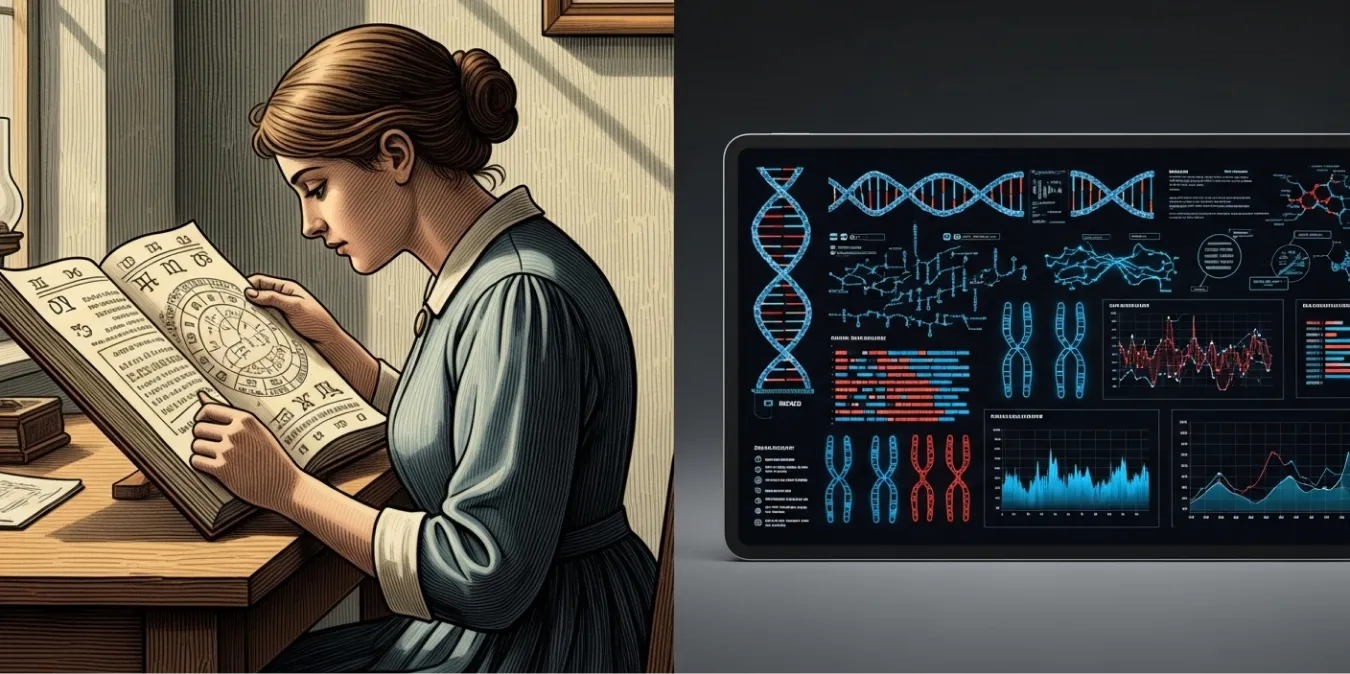 The desire to know what the future holds for a new life is as old as humanity itself. Long before advanced medical technology, expectant parents and their communities sought clues about their unborn child. This deep-seated curiosity, spanning millennia, has driven the development of countless methods, evolving from simple folklore to sophisticated artificial intelligence. Understanding this journey reveals not just technological progress, but also the enduring human need for connection and preparation.
The Ancient Roots of Baby Prediction History
For centuries, predicting a baby's characteristics, especially its gender, was a blend of tradition, superstition, and hopeful observation. This rich baby prediction history is filled with practices passed down through generations, offering comfort and a sense of control in times of uncertainty. These methods often relied on interpreting subtle signs or engaging in symbolic rituals.
Many cultures developed their own unique approaches. The ancient Mayans, for instance, used a calendar-based system, aligning the month of conception with the mother's age to forecast the baby's sex. Similarly, the Chinese Gender Chart, purportedly discovered in a royal tomb, offers a grid-based prediction using the lunar age of the mother and the lunar month of conception. While these charts provide a simple answer, their scientific accuracy remains unproven.
Other popular old wives' tales involved observing physical changes in the pregnant person. A high-carrying belly was often said to indicate a boy, while a low-carrying belly suggested a girl. Cravings also played a role; a desire for salty foods might mean a boy, and sweet cravings a girl. Even the mother's skin condition or hair texture was scrutinized for clues. These traditions, though lacking scientific basis, offered a shared experience and a fun way to engage with the pregnancy.
Beyond physical signs, various home tests gained popularity. The "ring test," for example, involved suspending a wedding ring on a string over the pregnant belly. If it swung in a circle, it was a girl; if it moved back and forth, a boy. Another common practice involved mixing the pregnant person's urine with baking soda; fizzing indicated a boy, no fizz a girl. These informal methods provided entertainment and fueled speculation among families, creating a sense of anticipation.
Early Scientific Forays and Medical Observations
As medical understanding advanced, the focus shifted from folklore to more systematic observation. Early physicians and midwives began to document patterns associated with pregnancy outcomes. While not sophisticated prediction tools by today's standards, these observations laid foundational knowledge.
One significant early medical observation involved the fetal heart rate. In the 19th century, doctors started noting differences in heart rates between male and female fetuses, though these were often inconsistent and not reliable for definitive prediction. Faster heartbeats were sometimes associated with girls, and slower ones with boys. This method, however, proved to be highly variable and influenced by many factors, including fetal activity and maternal stress.
Early medical practitioners also observed the severity and timing of morning sickness. Some theories suggested that severe morning sickness might indicate a girl due to higher levels of certain hormones. However, like heart rate, this observation was anecdotal and lacked rigorous scientific backing. These early attempts, while crude, marked a transition towards seeking physiological indicators rather than relying solely on cultural beliefs. They highlighted the emerging scientific curiosity about fetal development.
The Dawn of Modern Medical Imaging: Ultrasound's Impact
The mid-20th century brought a revolutionary change in prenatal care with the advent of ultrasound technology. This non-invasive imaging technique transformed how we view and understand fetal development, moving predictions from guesswork to visual confirmation. Ultrasound uses high-frequency sound waves to create images of the inside of the body.
When these sound waves encounter tissues and fluids, they bounce back, and a computer translates these echoes into a real-time image on a screen. For expectant parents, this means seeing their baby for the first time, often as early as the first trimester. The primary purpose of an ultrasound is to monitor fetal health, growth, and development, but it quickly became a reliable tool for gender prediction.
During a routine anatomy scan, typically performed between 18 and 22 weeks of pregnancy, a trained sonographer can often determine the baby's sex by visualizing the external genitalia. The accuracy of gender prediction via ultrasound is remarkably high, often exceeding 90-95%, provided the baby is in a cooperative position. However, it's not foolproof.
For example, a common constraint arises when the baby is curled up, or its legs are crossed, obscuring the view. In one observation from a prenatal clinic, a sonographer noted that a baby consistently kept its legs tightly crossed during two separate anatomy scans. Despite the advanced equipment, the baby's position made it impossible to definitively determine gender until a later follow-up appointment, highlighting that even with modern tech, the baby's cooperation is key. This illustrates that while powerful, ultrasound still has practical limitations based on the dynamic nature of a developing fetus.
Non-Invasive Prenatal Testing (NIPT) and Genetic Insights
The 21st century introduced another significant leap in baby prediction: Non-Invasive Prenatal Testing (NIPT). This advanced screening method offers insights into fetal genetics with remarkable accuracy, primarily by analyzing a simple blood sample from the pregnant person. NIPT represents a major step forward, as it avoids invasive procedures like amniocentesis, which carry a slight risk of miscarriage.
NIPT works by detecting small fragments of the baby's DNA that circulate freely in the pregnant person's bloodstream. These cell-free fetal DNA (cffDNA) fragments can be isolated and analyzed. By examining the presence or absence of specific sex chromosomes (X and Y), NIPT can determine the baby's gender with over 99% accuracy, often as early as 10 weeks of pregnancy. This makes it one of the earliest and most reliable methods for gender prediction available today.
Beyond gender, the primary purpose of NIPT is to screen for common chromosomal abnormalities, such as Down syndrome (Trisomy 21), Edwards syndrome (Trisomy 18), and Patau syndrome (Trisomy 13). It provides valuable information to expectant parents and healthcare providers, allowing for informed decisions and early preparation if a potential condition is identified. While NIPT is highly accurate for screening, it is important to remember it is a screening test, not a diagnostic one. Positive results typically require confirmation through diagnostic tests.
The introduction of NIPT has also sparked discussions about the ethics of early and highly accurate gender determination. While many parents appreciate the opportunity to plan, some concerns have been raised regarding potential gender selection in cultures where there is a strong preference for one sex. Healthcare providers often emphasize the medical benefits of NIPT, focusing on its role in identifying chromosomal conditions, while acknowledging its secondary utility for gender prediction.
The Rise of AI and Machine Learning in Pregnancy Prediction
The latest frontier in baby prediction involves artificial intelligence (AI) and machine learning (ML). These technologies are transforming how we analyze vast amounts of medical data, moving beyond simple observations to identify complex patterns that can predict pregnancy outcomes with unprecedented sophistication. AI refers to computer systems that can perform tasks typically requiring human intelligence, while machine learning is a subset of AI where systems "learn" from data without explicit programming.
In the context of pregnancy, AI algorithms are trained on enormous datasets. These datasets include anonymized patient medical records, genetic information, ultrasound images, blood test results, and even lifestyle factors. By processing this information, AI can identify subtle correlations and risk factors that might be imperceptible to the human eye. This capability allows for more personalized and potentially earlier predictions regarding various aspects of pregnancy. For a practical breakdown of image-based prediction, see How AI Baby Generator Works: A Guide to Future Faces.
Current applications of AI in prenatal care are diverse. For instance, AI models are being developed to predict the risk of conditions like pre-eclampsia, gestational diabetes, and preterm birth. They can analyze a pregnant person's health history, current test results, and even demographic data to generate a risk score. This allows healthcare providers to intervene earlier, potentially improving outcomes for both parent and baby.
Consider a practical application: Researchers at a major university hospital developed an AI model trained on thousands of anonymized patient records, including blood pressure readings, urine protein levels, and demographic data. In a test scenario, the AI successfully flagged 85% of patients who later developed pre-eclampsia, often weeks before clinical symptoms became obvious. This early warning allowed doctors to implement closer monitoring and preventive strategies, illustrating how AI acts as a powerful assistive tool for medical professionals. This example highlights AI's potential to enhance, not replace, clinical judgment.
How AI Algorithms Learn to Predict
At its core, AI's predictive power comes from its ability to learn from data. Machine learning algorithms, particularly those based on neural networks, mimic the way the human brain processes information. They are fed vast quantities of labeled data—for example, ultrasound images labeled as "normal" or "showing a specific anomaly"—and they learn to identify the distinguishing features.
Imagine an AI algorithm as a student learning to differentiate between different types of fruit. Initially, you show it many pictures of apples, bananas, and oranges, each clearly labeled. Over time, the student learns the unique characteristics of each fruit: color, shape, texture. Similarly, an AI model learns to recognize patterns in medical data. It might identify subtle textures in an ultrasound image that correlate with a particular fetal condition, or complex interactions between blood markers that indicate a risk for preterm labor.
The input data for these algorithms can be incredibly varied. It includes numerical data from blood tests, categorical data from patient questionnaires, and image data from ultrasounds or MRIs. The AI processes this input through multiple layers of computation, refining its understanding with each piece of data. The output is often a probability score or a classification, such as "high risk" or "low risk" for a specific condition. This learning process allows AI to make predictions that are increasingly accurate as it is exposed to more data.
Current Applications and Limitations of AI in Baby Prediction
While AI holds immense promise, its current applications in baby prediction are primarily focused on risk assessment and pattern recognition, rather than definitive future telling. AI excels at identifying subtle patterns in large datasets that might indicate a higher likelihood of certain outcomes. For example, it can predict the probability of a pregnant person developing gestational diabetes based on their medical history, genetic predispositions, and current glucose levels.
AI is also being used to improve the accuracy of medical imaging analysis. Algorithms can assist radiologists in detecting anomalies in ultrasound images, potentially catching issues that might be missed by the human eye, especially in complex cases. Some AI models are even being explored for more precise estimations of gestational age or fetal weight.
However, it is crucial to understand what AI cannot do. It cannot predict the exact personality traits of a child, their future talents, or the precise moment of birth with 100% certainty. AI is a statistical tool; it provides probabilities based on observed data, not absolute guarantees. Its predictions are only as good as the data it's trained on. Biased or incomplete datasets can lead to biased or inaccurate predictions.
Furthermore, significant ethical considerations surround the use of AI in healthcare. Data privacy is paramount, as these systems rely on sensitive patient information. There are also concerns about algorithmic bias, where AI models might inadvertently perpetuate or amplify existing health disparities if the training data is not diverse and representative. The need for human oversight remains critical. Doctors must interpret AI-generated insights within the broader clinical context, using them as a decision-support tool rather than an autonomous oracle.
The Future Landscape: Personalized Predictions and Ethical Considerations
Looking ahead, the future of baby prediction tools is likely to be characterized by even greater personalization and integration of various data sources. Wearable technology, for instance, could play a larger role, continuously monitoring physiological data like heart rate, sleep patterns, and activity levels. This real-time data, combined with genetic information and traditional medical records, could feed into sophisticated AI models to provide highly individualized risk assessments and health recommendations.
Imagine a future where an AI-powered app, under medical supervision, could alert an expectant parent to subtle changes in their biometric data that suggest an increased risk of a specific complication, prompting them to consult their doctor. This proactive approach could lead to earlier interventions and better health outcomes. We might also see more refined AI models that can predict responses to specific treatments or tailor nutritional advice based on individual genetic profiles.
However, with these advancements come significant ethical dilemmas. The ability to predict more about a baby's future health or predispositions raises questions about the psychological impact on parents. How much information is too much? Could extensive prediction lead to increased anxiety or even discrimination? There are concerns about data security and who has access to such sensitive personal and genetic information. Ensuring equitable access to these advanced tools, preventing a digital divide in healthcare, will also be a critical challenge.
Ultimately, these tools are powerful aids designed to enhance understanding and improve care, not to remove the mystery and joy of parenthood. It is essential to remember that these technologies serve as informational resources and should never replace the expert advice and compassionate care of medical professionals.
Balancing Curiosity with Reality: A People-First Approach
The journey from old wives' tales to AI-driven predictions reflects humanity's enduring fascination with the unknown. This desire to peer into the future of a new life is deeply human, rooted in a need for preparation, connection, and a sense of control. While ancient methods offered comfort and community, modern tools provide unprecedented levels of accuracy and insight into health and development.
A people-first approach to baby prediction acknowledges this innate curiosity while emphasizing the importance of context and balance. It recognizes that while technology can offer valuable information, it should enhance the human experience of pregnancy and parenthood, not diminish it. The joy of surprise, the unique bond formed during pregnancy, and the unconditional love for a child remain central, regardless of how much is known beforehand.
Modern prediction tools, from ultrasounds to NIPT and AI, serve as powerful resources for healthcare providers and expectant parents. They enable earlier detection of potential health issues, facilitate informed decision-making, and allow for better planning. However, they are just tools. They provide probabilities and insights, not definitive blueprints for a child's life. The magic of a new baby lies in their individuality and the unfolding journey of discovery.
It is vital to approach these predictions with a healthy perspective. Embrace the information that helps ensure a healthy pregnancy and baby, but also cherish the unknowns. The most profound predictions about a child's future are not found in algorithms or ancient charts, but in the love, care, and opportunities they receive. Always consult with qualified medical professionals for any health concerns or decisions related to pregnancy and childbirth.
Conclusion
The evolution of baby prediction tools is a testament to human ingenuity and our persistent quest for knowledge. From the charming superstitions of old wives' tales to the precise imaging of ultrasound, the genetic insights of NIPT, and the complex pattern recognition of artificial intelligence, each era has sought to demystify the miracle of birth. Today, we stand at a fascinating intersection where ancient curiosity meets cutting-edge technology.
While AI promises even more personalized and detailed insights into fetal development and potential health outcomes, it also brings new responsibilities regarding data privacy, ethical use, and equitable access. The journey of baby prediction has always been about more than just knowing; it's about preparing, connecting, and celebrating the arrival of new life. As technology continues to advance, the most valuable prediction will always be the promise of love and care that awaits every child.
Frequently Asked Questions (FAQ)
Q1: How accurate are old wives' tales for predicting a baby's gender?
Old wives' tales, such as those based on belly shape or food cravings, are not scientifically accurate and offer no reliable prediction for a baby's gender. They are primarily for fun and tradition.
Q2: What is the earliest and most accurate way to determine a baby's gender medically?
Non-Invasive Prenatal Testing (NIPT) can determine a baby's gender with over 99% accuracy as early as 10 weeks of pregnancy by analyzing cell-free fetal DNA in the pregnant person's blood.
Q3: Can AI predict specific personality traits or talents of an unborn baby?
No, current AI technology cannot predict specific personality traits, talents, or other complex individual characteristics of an unborn baby. AI focuses on statistical risk assessment for health conditions and developmental patterns based on available medical data.
Q4: Is AI replacing doctors in prenatal care?
No, AI is designed to be a powerful assistive tool for healthcare professionals, not a replacement. It helps doctors analyze vast amounts of data and identify patterns, enhancing their ability to make informed decisions and provide personalized care.


